Store
Store
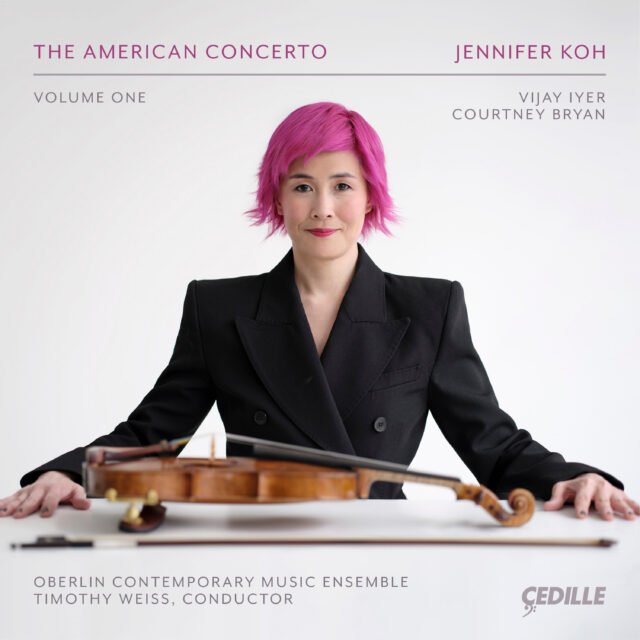
The American Concerto, Volume One
Vijay Iyer, Courtney Bryan, Timothy Weiss, Oberlin Contemporary Music Ensemble
Grammy Award-winning violinist Jennifer Koh’s 16th album on Cedille Records, The American Concerto, Volume One, features Vijay Iyer’s Trouble and the world premiere recording of Courtney Bryan’s Syzygy, performed with the Oberlin Contemporary Music Ensemble conducted by Tim Weiss. The album launches a new recording series showcasing works commissioned through Koh’s The American Concerto project. A “tireless champion of new music” (The New York Times), Koh created The American Concerto, asking composers to reimagine the violin concerto for the 21st century to create works that reflect American experiences, stories, and identities.
Praised as “one of the best in the world at what he does” (Pitchfork), Iyer composed Trouble as a response to discrimination, social struggle, and the immigrant experience. Premiered at the 2017 Ojai Music Festival, the work takes its title from Congressman John Lewis’s reflection on the Montgomery Bus Boycott: “I got in trouble. It was good trouble. It was necessary trouble.” Hailed for its “energy and dazzle” (The Wall Street Journal), Trouble confronts racial violence and anti-Asian prejudice through a journey of birth, realization, collective resistance, and elegy. The concerto’s third movement is dedicated to Vincent Chin, the Chinese American man killed in a racially motivated assault in Detroit in 1982 — an event that deeply affected the Asian American community and resonated with Koh, who was five years old at the time.
“A pianist and composer of panoramic interests” (The New York Times), Courtney Bryan composed Syzygy for Koh, the Chicago Sinfonietta, and conductor Mei-Ann Chen. Following its 2019 premiere, the Chicago Tribune hailed the work as “a triumph for composer, soloist and the Sinfonietta.” Inspired by visual artists Alma Thomas, Frida Kahlo, and Maya Lin, Syzygy celebrates women through three interconnected movements. Its title refers to the alignment of celestial bodies during an eclipse, while the music draws on influences ranging from Prokofiev and jazz to Bryan’s upbringing in the Church. Since launching The American Concerto in 2017, Koh has commissioned additional works for the project from Nina Young, Missy Mazzoli, Tyshawn Sorey, Lisa Bielawa, and Christopher Cerrone.
This recording is made possible by the generous support of Patricia A. Kenney and Gregory J. O’Leary
Preview Excerpts
VIJAY IYER (b. 1971)
Trouble
COURTNEY BRYAN (b. 1982)
Syzygy
Artists
1: Jennifer Koh
Oberlin Contemporary Music Ensemble
Timothy Weiss, Conductor
2: Jennifer Koh
Oberlin Contemporary Music Ensemble
Timothy Weiss, Conductor
3: Jennifer Koh
Oberlin Contemporary Music Ensemble
Timothy Weiss, Conductor
4: Jennifer Koh
Oberlin Contemporary Music Ensemble
Timothy Weiss, Conductor
5: Jennifer Koh
Oberlin Contemporary Music Ensemble
Timothy Weiss, Conductor
6: Jennifer Koh
Oberlin Contemporary Music Ensemble
Timothy Weiss, Conductor
7: Jennifer Koh
Oberlin Contemporary Music Ensemble
Timothy Weiss, Conductor
8: Jennifer Koh
Oberlin Contemporary Music Ensemble
Timothy Weiss, Conductor
9: Jennifer Koh
Oberlin Contemporary Music Ensemble
Timothy Weiss, Conductor
Program Notes
View Album BookletThe American Concerto Project
Notes by Jennifer Koh
What does it mean to represent America today through classical music? How can we draw upon the cultural richness of our country and engage in a dialogue that reflects the multiplicity of experiences that shape our lives? I believe that when our stages more fully reflect the world around us, classical music becomes stronger, more relevant, and more capable of inspiring future generations of musicians and audiences. There is space in our musical life for all of us and for all of our stories.
The American Concerto grew out of these questions. Through this ongoing commissioning project, I invite composers to engage with the traditional form of the violin concerto as a way of exploring contemporary American life. Each composer is asked to draw from personal experience and to consider how the concerto — a centuries-old form centered on the relationship between the individual and the collective — can speak to the realities of the 21st century.
The project is both an exploration of cultural identity and an examination of the concerto itself. I ask composers to reconsider long-held assumptions about the form: Is the soloist still the heroic figure inherited from the Romantic tradition, or can the relationship between soloist and orchestra take on new meanings? How might the concerto reflect collaboration rather than opposition, community rather than individualism? The dynamic between one voice and many voices offers a powerful metaphor for contemporary society, and the composers in this project are uniquely positioned to explore its expressive possibilities.
Trouble for Violin and Chamber Orchestra
Notes by Vijay Iyer
“Good trouble,” “necessary trouble” — these are favorite phrases of U.S. Representative John Lewis, referring to the strategies and tactics of the Civil Rights movement and ongoing struggles for equality and justice over the last six decades.
As I met with Jennifer Koh during the year of composition to discuss the details of this piece, I often found it difficult to focus. Typically, we found ourselves, instead, recoiling in horror at the events of any given day. This pattern only intensified after January 20, 2017, as we found our communities, our country, and our planet in greater peril with each passing hour. In creating the piece, I found myself both channeling and pushing against the sensation of extreme precarity that continues to pervade our moment.
I didn’t want to rehash the typical concerto narrative, positioning a heroic individual over or against a multitude. Ms. Koh told me that the soloist could instead be viewed as someone willing to be vulnerable, to venture publicly where most people won’t, to accept a role that no one else will accept, to bear the unbearable. In other words, the soloist can embody the relationship of an artist to her community: not so much a “leader” or “hero,” but something more like a shaman, a conduit for the forces in motion around us.
The third movement is dedicated to Vincent Chin, whose murder in the early 1980s signaled an ongoing pattern of violent hate crimes against people of color. His death became a watershed moment for antiracist activism, which is as urgently needed today as it has ever been.
Syzygy
Notes by Courtney Bryan
I wrote Syzygy for Jennifer Koh and the Chicago Sinfonietta as part of Jennifer’s The American Concerto project. The piece grew out of my admiration for the work of three artists, whose creativity, vision, and engagement with the world have long inspired me: painter Alma Thomas (1891–1978); painter Frida Kahlo (1907–1954); and designer, architect, and artist Maya Lin (b. 1959).
The title Syzygy refers to the nearly straight-line configuration of three celestial bodies in a gravitational system, such as the sun, moon, and earth during a solar or lunar eclipse. Across the concerto’s three movements, I explore different manifestations of eclipse, drawing on the imagery, symbolism, and visual perspectives found in the following works: Thomas’s The Eclipse (1970), whose vivid colors and imagery suggest both illumination and obscurity; Kahlo’s Tree of Hope, Keep Firm (1946), with its symbolism of sun and moon; and Lin’s Eclipsed Time (1994), an installation that transforms a familiar public space through shadow and light. Throughout the concerto, Jennifer’s violin serves as a connective thread, guiding the listener through these three artistic worlds.
Album Details
Producer Judith Sherman
Engineer Bill Maylone
Assistant Engineers Andrew Tripp, Andrew Garver
Recorded
January 25–28, 2026, Warner Concert Hall at Oberlin College & Conservatory
Publishers
Syzygy © 2019 Boosey & Hawkes Music Publishers
Trouble © 2017 Schott Music
Cover Photo Juergen Frank
Graphic Design Bark Design
CDR 90000 244