Store
Coming soon – Out November 13
“Powerhouse” (Chicago Tribune) composer Mischa Zupko and Grammy-winning saxophonist Timothy McAllister highlight their decades of collaboration on this upcoming release. The album showcases the breadth of Zupko’s artistry with new compositions for this distinctive instrument. Chicago chamber groups ~Nois Quartet and Civitas Ensemble join on this unique record.
Preview Excerpts
MISCHA ZUPKO (b. 1971)
MISCHA ZUPKO (b. 1971)
MISCHA ZUPKO (b. 1971)
From the Skyline
MISCHA ZUPKO (b. 1971)
MISCHA ZUPKO (b. 1971)
MISCHA ZUPKO (b. 1971)
MISCHA ZUPKO (b. 1971)
In Transit
ED SARCHÉ
Artists
1: Timothy McAllister; Mischa Zupko, piano
2: Timothy McAllister; Mischa Zupko, piano
3: Timothy McAllister; Mischa Zupko, piano
4: Timothy McAllister; Mischa Zupko, piano
5: Timothy McAllister; Mischa Zupko, piano
6: Timothy McAllister; Civitas Ensemble
7: ~Nois Quartet
8: Timothy McAllister; Civitas Ensemble
9: Timothy McAllister; Mischa Zupko, piano
10: Timothy McAllister; Mischa Zupko, piano
11: Timothy McAllister; Mischa Zupko, piano
12: Timothy McAllister; Mischa Zupko, piano
13: Timothy McAllister; Mischa Zupko, piano
14: Ed Sarché
Program Notes
In Sympathy
Notes by Mischa Zupko
Tailgate (2021) is a short ride for soprano saxophone and piano exploring danger, high speed, and road rage. The saxophone leads off with a stuttering musical line followed by the same irregular line in the piano two and a half measures later. The entire piece is, in fact, a strict relative-time canon between the two parts where the follower (the piano) inches closer and closer to the leader (the sax) throughout, like an irate driver pursuing lane-based justice. Justice, or something like it, prevails in the denouement, where the piano finally “catches up” and the two parts play in unison, vying for supremacy amidst jarring leaps and accents to the bitter end. Tailgate was commissioned by and is dedicated to Cristopher and Hannah Creviston.
I composed Simple Song in 2019, upon learning of the death of my friend and longtime champion, Dr. Frederick Hemke. An icon of the classical saxophone world, Fred was admired not only for his artistry but also for the love and respect he showed those he mentored and inspired. For me, Fred was a transformative figure. When I was a piano student at Northwestern, he inspired me each week as I played for his students. He later commissioned my work and helped bring my saxophone music to audiences throughout the world. He gave generously and without expectation, sustained by an abundance of light, life, and music that he readily shared with everyone he encountered. Simple Song is a tribute through which I express the depth of my gratitude in a way words never could.
There is little to explain about the piece itself. It is my response to Fred’s intense love of pure, unadorned melody. The piece embraces that quality throughout, as its melody gradually gives way to, and ultimately becomes, a quotation from Debussy’s “Voiles” (“Sails”). I am not entirely sure why this music came to me at that moment. Perhaps I was remembering the cover of Fred’s album, Simple Gifts, where he is pictured on Lake Michigan, his constant backdrop, and imagining him sailing beyond the horizon into a mysterious eternity filled with the music he loved.
From the Skyline (2022), for tenor saxophone and piano, is a three-movement work inspired by mesmerizing views from a 15th-story Chicago apartment. The first movement, Crystal, obsesses over the infinite ice formations that evolve daily during the coldest days of the winter months along the coast of Lake Michigan. Both frozen and fluid, these intricate sculptures imbue a sense of mystery captured in the music’s ever-varying arabesques and layered harmonies. Chasing Moonlight fixates on reflected moonbeams dancing off the water and into the living room. An air of stillness, akin to the experience of witnessing a cosmic rarity, saturates this movement amidst a gentle, rolling tide that plays with light and shade, intensity and resignation, fulfillment and longing. The third movement, Brick and Steel, is an ode to the great city of Chicago, whose skyline, visible from the southern windows, stands as a testament to the ingenuity of some of the greatest creative minds of the modern age; a true work of art that does not pale in the face of its pristine natural surroundings, but rather intensifies their beauty. The music celebrates this city’s vibrancy with a hard-edged approach that employs “found” percussion instruments the pianist plays at various points throughout. Angular and rapid, always on the move, this compact essay subjects a short rhythmic idea, stated at the beginning, to a vast array of treatments, showcasing the tenor sax in the middle in a fiendish, Coltraine-like solo, accompanied only by a triangle and various “drum” fills. From the Skyline was commissioned by a collective of 30 saxophonists organized as the Contemporary Tenor Repertoire Initiative by saxophonist Jeffrey Vickers. The composer gratefully acknowledges the consortium’s members for their support and for the life they have given the work.
I wrote Anechoic Rhapsody on a 2020 commission, at the start of the COVID-19 pandemic, as the world was being asked to shelter-in-place. The world changed overnight and brought with it an intense quiet and solitude never before experienced. Heartbeat and breath became audible and reflection was inevitable. It was enough to drive one mad and also a potential source of healing. The periodicity of breath and heartbeat are central to this work and take the form of repeating gestures that undulate and pulse. At times, the pulsing is even in nature; at other times it varies widely in speed, progressing rapidly between slow and fast tempos. At yet other times, the pulses of the various instruments diverge from one another, producing something akin to a sense of drifting into reverie. The range of experience spans from meditative to untethered, and the work ultimately climaxes with the piano alone, a voice that had previously remained relatively subordinate, as if consciousness itself was awakened and moved by a revelation.
The anechoic chamber, referenced by the title, is a completely soundproof environment used for testing audio products. Reputedly, most people cannot stay within it for longer than 45 minutes at a time, some needing to leave immediately. The awareness of one’s own blood flowing through organs and the sound of bones moving at the turn of a head can stir awareness of the fragility of life. A frightening prospect, but it is precisely this fragility that makes life so precious and causes us all to dream beyond the confines of our experience. There is beauty and healing in the quiet. This work was commissioned by the Civitas Ensemble and dedicated to Judy McCue, all of whom engaged in the process of developing the concept behind this work and to whom I’m truly grateful.
Quantum Shift (2021), for saxophone quartet, is an 8-minute work of intense virtuosity inspired by the mysteries of the subatomic. A quantum shift is a movement of an electron from one orbit to another with the fascinating property that there is no discernible transition between orbits; it is as if the electron simply ceases to exist in one orbit and magically appears in another. This phenomenon is imagined in the music’s abruptly changing states in terms of figuration, texture, tempo, and gesture. At the atomic level, however, the music is conceived entirely from a single, three-note cell that issues from the start in rapid-fire exchange among the four saxophones. The result is an ensemble tour de force, demanding absolute precision and synergy among the members of the quartet to convey the sudden shifts of energy that define work’s structure. Quantum Shift was commissioned by the Kenari Quartet in consortium with the Donald Sinta Quartet, Barkada Quartet, ~Nois, Fuego Quartet, Zzyzyx Quartet, Project Fusion Saxophone Quartet, Assembly Quartet, and Mirasol Quartet.
Scored for saxophone, violin, cello, piano, and a chorus of nine resonating wine glasses, In Sympathy (2024) is a collaboration with Fermilab National Accelerator Laboratory (where I was the 2024 Fermilab Research Alliance guest composer) and the esteemed Civitas Ensemble, featuring Winston Choi, Yuan-Qing Yu, and Ken Olson, with guest saxophonist Timothy McAllister. I was inspired to write the piece during conversations with theoretical physicists Chris Quigg and Luis Mendoza. My conversation with Chris introduced me to the use of resonance as a tool for particle discovery, a concept I found fascinating and decidedly musical. In a subsequent conversation, Luis’s insights into quantum field theory, where particles emerge as resonant excitations in underlying fields, further deepened the idea of resonance as a principle that connects science and art. From this inspiration came the desire to explore the phenomenon of sympathetic resonance, a physical process whereby one object is coaxed into vibration via the excitation of another sharing its resonant frequency. My vision was to create a system in which acoustic instruments would trigger a chorus of tuned wine glasses to ring out in response based (solely) on this principle.
Over the course of a year, I conceived and designed the resonance system and its underlying architecture, developing both the physical glass units and the logic by which instrumental sound is detected, qualified, and translated into resonance. Bringing the system to life involved an extended process of experimentation and collaboration. I owe a profound debt of gratitude to my generous collaborators, without whom this project could never have taken shape:
- Brad Robin, who served as the principal Max programmer, working closely with me to implement and refine the patch architecture and devise technical solutions as the system evolved.
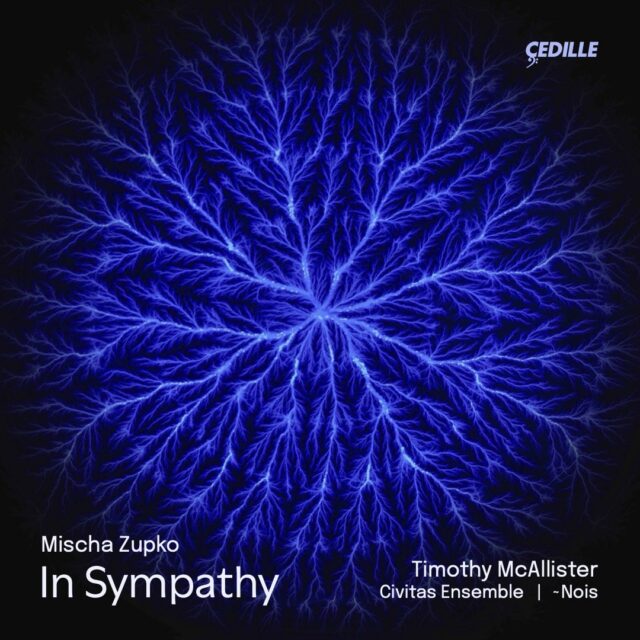
- Todd Johnson, who collaborated closely on the development and refinement of the resonating apparatus, bringing his technical expertise to the many experiments that shaped the final system. In addition to developing the custom magnetic transducers and assembling the piezo pickups (small electronic devices that turn the physical vibrations of an instrument into electrical audio signals), Todd created the “accelerator artwork” featured on the album cover: a “Lichtenberg figure” realized by electrically charging a plate and then releasing the charge to reveal the resulting branching paths traveled by the electrons.
- Timothy McAllister and the Civitas Ensemble, whose early testing of the system helped reveal and refine the musical potential of these resonant materials.
At its core, In Sympathy reflects on how resonance as a multifaceted concept relating to sound, science, and society, can illuminate the structures that link seemingly separate entities. Just as the instruments and glasses respond across space through shared frequencies, this piece allows us to experience how meaningful connection arises not from uniformity, but from the ability to respond, adapt, and move in relation to one another. In this way, In Sympathy becomes both a musical and conceptual exploration of what it means to coexist in ways that foster creativity.
Timothy McAllister commissioned In Transit in spring 1999. I wrote the work during a period of self-discovery, when I was mining previously unexplored sources among my musical influences. I imagined the piece as a travelogue, with each movement taking my music into a new environment, both stylistically and sonically. At the same time, I wanted to maintain a sense of continuity from one movement to the next, as though the work followed a traveler whose perception of each new experience became increasingly colored by earlier encounters.
The destinations along the way include an impressionistic landscape inspired by the dense fogs of Seattle; the lively sounds of salsa spilling from clubs in Miami; a journey into the past that reimagines a melancholy song that my maternal grandfather wrote in the 1940s; a breathless, cadenza-like movement recounting a drive through the busy streets of Manhattan; and a contemporary jazz reverie reflecting on the journey. My grandfather’s song, “So Alone Am I,” provides musical material for all five movements, creating continuity across their diverse styles and sound worlds.
The most literal presentation of my grandfather’s song occurs in the third movement, which bears its title, while the surrounding movements lead toward and away from this central point through motivic fragments drawn from the song. This is perhaps most evident in the scherzo-like second movement, “Mango Café.” Here, an aggressive salsa dance is interrupted several times by slower, ethereal passages quoting the opening of “So Alone Am I.” These fragments reappear in different contexts until the third movement, which follows without pause. There, the missing pieces of the melody are gradually assembled, culminating in a complete, literal quotation near the movement’s end, revealing the source and inspiration for this eclectic journey.
Written in memory of my grandfather, Ed “Papa” Sarché, In Transit is dedicated to Tim McAllister.
Album Details
Producer James Ginsburg
Engineer Bill Maylone
Editing Assistance Jeanne Velonis
Recorded
July 10-11 and September 12–15, 2025 and March 6–7, 2026, Mary Patricia Gannon Hall (DePaul University, Chicago)
Publishers
Anechoic Rhapsody © 2020 Sarché Publishing
In Sympathy © 2025 Sarché Publishing
Tailgate ©2015 Sarché Publishing
In Sympathy ©2019 Sarché Publishing
Cover Photo Todd Johnson
Graphic Design Bark Design