Store
Store
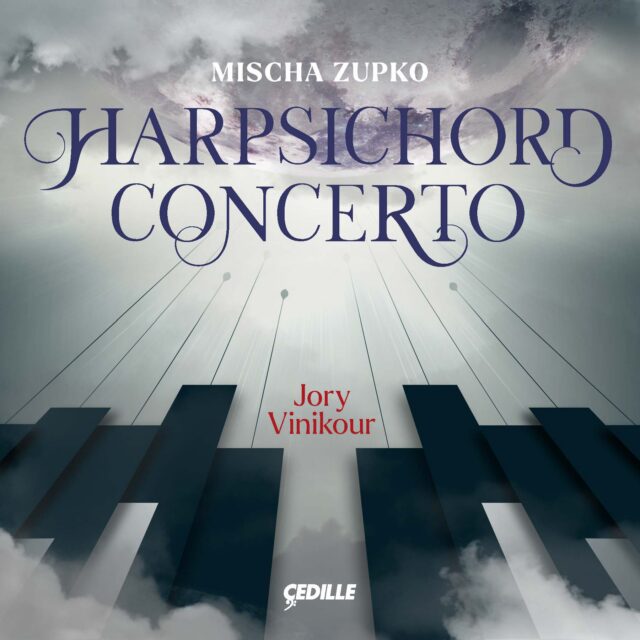
Mischa Zupko: Harpsichord Concerto
Desirée Ruhstrat, Charlene Kluegel, Margaret O'Malley, David Cunliffe
This world-premiere recording of Chicago composer Mischa Zupko’s 2002 Harpsichord Concerto, scored for harpsichord and string quartet, spotlights two-time Grammy-nominated American harpsichordist Jory Vinikour, praised for his “sense of spontaneity and security” (San Francisco Chronicle). He is joined by a quartet of artists known for their longstanding collaboration, refined ensemble playing, and combination of technical command and bold interpretive choices: multi-Grammy-nominated violinist Desirée Ruhstrat, hailed for her “intensive fire, sleepwalking assuredness, and deeply grounded musical personality” (Berlin Tagesspiegel); violinist Charlene Kluegel, recognized for her “unsentimental verve, musical feeling, and great technical skill” (New York Classical Review); rising Chicago-based violist Margaret O’Malley, a multi-award-winning artist; and cellist David Cunliffe, “a cellist whose polish gives way to moments of artful recklessness” (WQXR).
The piece draws on influences from J.S. Bach’s motor-rhythmic Prelude in C Minor (Well-Tempered Clavier, Book I), François Couperin’s French-style ornamentation, and Domenico Scarlatti’s bright and percussive keyboard writing. Traveling through three movements, the concerto is naturally propelled by writing that fits the harpsichord’s traditional format, and is brought into contemporary tonality through the reshaping of older musical styles into a modern expression.
In the first movement, “Preamble,” the harpsichord deploys a continuous 16th-note pattern, reminiscent of Bach’s C-minor Prelude, while the strings enter with sustained notes that support the harmony. As the harpsichord shifts harmonically, the strings lag and fall out of alignment, gradually creating wildly different textures between the two parts. The second movement, “Whispers,” incorporates French techniques, with the harpsichord performing ornate trills characteristic of Couperin’s compositional style. Creating a colorful, impressionistic texture, the harpsichord is distanced from the string quartet, becoming a voice of longing, against the quartet as a voice from the beyond. The final movement, “The Dance,” is inspired by the Baroque tradition of such endings and Scarlatti’s upbeat keyboard writing. Opening with a ritornello that recurs several times throughout the movement, the theme is developed through interventions by the string quartet, creating striking contrasts with the straightforward presentation of the dance theme, including breaking into a tango.
The Harpsichord Concerto marks Zupko’s third release on Cedille Records, Vinikour’s fourth, Ruhstrat and Cunliffe’s 14th, and Kluegel and O’Malley’s first. The work was made possible by a grant from the Fromm Music Foundation.
Preview Excerpts
MISCHA ZUPKO (b. 1971)
Harpsichord Concerto
Artists
1: Mischa Zupko, composer; Jory Vinikour, harpsichord
2: Mischa Zupko, composer; Jory Vinikour, harpsichord
3: Mischa Zupko, composer; Jory Vinikour, harpsichord
Program Notes
View Album BookletNotes by Mischa Zupko
I wrote my three-movement Harpsichord Concerto for harpsichordist Bradley Brookshire, who premiered it with the Corigliano String Quartet at New York’s Merkin Hall in 2003. My underlying thrust in this work was to take the height of idiomatic writing for harpsichord into a modernday expression through the transformation of antiquated stylistic mannerisms.
I fashioned the first movement, Preamble, after J.S. Bach’s motorrhythmic Prelude in C Minor (Well-Tempered Clavier, Book I). The harpsichord deploys the continuous 16th-note pattern of the C-minor Prelude while the strings enter with sustained notes that support the harmony of the harpsichord part. As the harpsichord shifts harmonically, the strings lag behind and the harmonic fields between the two parts fall out of alignment, creating wildly different sonorities. The rest of the movement is structured on this principle of the two parts going in and out of phase.
The second movement uses French style ornamentation ala Couperin as its point of departure. The harpsichord’s ornate trills and other decorations serve as the main material for the quartet, creating an impressionistic texture full of filigree and color. In this movement, I sought to create a distance between the harpsichord and the string quartet, treating the harpsichord as a voice of mourning or longing and the quartet as a voice from the beyond.
The last, and longest, movement adopts the Baroque tradition of ending with an upbeat dance and draws inspiration from the crunchy, diatonic dissonances that are so characteristic of Domenico Scarlatti’s keyboard writing. The opening dance theme is a ritornello that comes back several times over the course of the movement. Fragments of this theme are developed in the intervening sections, which create striking contrasts with the straightforward presentations of the dance theme. In one mutation, the material gradually takes the form of a tango, which leads to the movement’s conclusion.
This work was made possible by a grant from the Fromm Music Foundation.
Album Details
Producer James Ginsburg
Engineer Bill Maylone
Recorded November 11, 2025, Reva and David Logan Center for the Arts at the University of Chicago
Harpsichord John Phillips (Berkeley, CA) 2004
Franco-Flemish design after Ruckers-Taskin
Publisher © 2002 Sarché Publishing
Graphic Design Bark Design
CDR 3030