Store
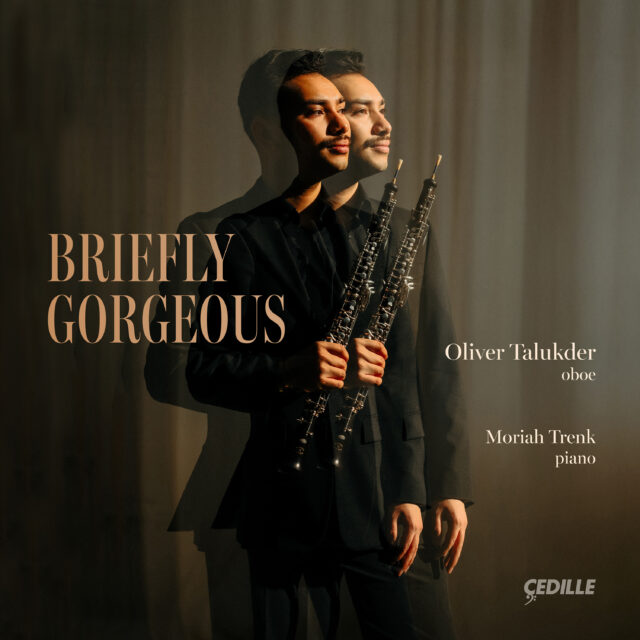
Winner of Cedille Records’ 2025 Emerging Artist Competition, Chicago-born oboist Oliver Talukder makes his solo recording debut with Briefly Gorgeous. Joined by pianist Moriah Trenk, Talukder presents an album inspired by themes of identity, love, family, and belonging. Drawing on his Mexican and Bengali heritage and his Chicago upbringing, the program explores where classical music intersects with Latino and South Asian traditions, creating a musical portrait shaped by Talukder’s own story.
A graduate of the Curtis Institute of Music currently pursuing graduate studies at The Juilliard School, Talukder performs on oboe, English horn, flute, and piccolo, bringing exceptional versatility to imaginative programming, original arrangements, and the music of diverse composers. Taking its title from Ocean Vuong’s On Earth We’re Briefly Gorgeous, the album brings together works by Jeffrey Agrell, Marina Dranishnikova, Alyssa Morris, Florence Price, Reena Esmail, and Arturo Márquez that mirror Talukder’s own artistic journey, revealing a musical voice shaped as much by experience as by technical virtuosity.
Jeffrey Agrell’s Blues for D.D. pushes the oboe to its technical and stylistic limits, blending blues, swing, bebop, and Latin rhythms into a dazzling showpiece that showcases Talukder’s remarkable versatility. Marina Dranishnikova’s Poème reveals one of the 20th century’s overlooked musical voices through a deeply expressive meditation on love, longing, and loss, offering a striking contrast to the album’s more extroverted works. Morris’s Four Personalities transforms the four archetypes of the Hartman Personality Test into vivid musical portraits, capturing the contrasting energies of “Yellow,” “White,” “Blue,” and “Red” through four distinctive movements.
Talukder contributes two original arrangements that broaden the repertoire for the woodwind family. The five songs by Florence Price feature Talukder alternating between oboe and English horn, bringing new colors to the composer’s vocal writing, while Arturo Márquez’s Danzón No. 2 showcases his command of flute and piccolo (as well as oboe and English horn). Esmail’s Jhula Jhule offers a poignant exploration of heritage and memory, weaving together Indian folk melodies passed down through the composer’s family and reflecting her journey between Indian and Western musical traditions.
Cedille Records’ Emerging Artist Competition, sponsored by the Zell Family Foundation, awards an exceptional Chicago-based musician a fully funded solo recording debut, introducing their artistry to audiences around the world. Briefly Gorgeous was produced by James Ginsburg and engineered by Bill Maylone. The album was recorded September 29–October 1, 2025 at the Reva and David Logan Center for the Arts at the University of Chicago.
Briefly Gorgeous is made possible by the generous support of Nancy Dehmlow, Lori Julian for the Julian Family Foundation, Patricia Kenney & Gregory O’Leary, Olga & Darin Walsh, Glory & Lynn Witherspoon, Helen Zell, and guests at Soirée Cedille 2025
Preview Excerpts
JEFFREY AGRELL
MARINA DRANISHNIKOVA
ALYSSA MORRIS
Four Personalities
FLORENCE PRICE, ARR. OLIVER TALUKDER
Five Songs
REENA ESMAIL
ARTURO MÁRQUEZ, ARR. OLIVER TALUKDER
Artists
1: Oliver Talukder, oboe
Moriah Trenk, piano
2: Oliver Talukder, oboe
Moriah Trenk, piano
3: Oliver Talukder, oboe
Moriah Trenk, piano
4: Oliver Talukder, oboe
Moriah Trenk, piano
5: Oliver Talukder, oboe
Moriah Trenk, piano
6: Oliver Talukder, oboe
Moriah Trenk, piano
7: Oliver Talukder, English horn
Moriah Trenk, piano
8: Oliver Talukder, oboe
Moriah Trenk, piano
9: Oliver Talukder, oboe
Moriah Trenk, piano
10: Oliver Talukder, English horn
Moriah Trenk, piano
11: Oliver Talukder, oboe
Moriah Trenk, piano
12: Oliver Talukder, oboe
Moriah Trenk, piano
13: Oliver Talukder, oboe, English horn, flute & piccolo
Moriah Trenk, piano
Program Notes
View Album BookletPersonal Note
Notes by Oliver Talukder
“If, relative to the history of our planet, an individual life is so short, a blink, as they say, then to be gorgeous, even from the day you’re born to the day you die, is to be gorgeous only briefly.”
— Ocean Vuong, On Earth We’re Briefly Gorgeous
The summer of 2023 was a turning point in my life. For the first time, I didn’t spend the entire season playing at a music festival. Instead, I mostly remained in the humid, swampy heat of Philadelphia, confronted with something unfamiliar: time alone. It became a summer of self-discovery, love, and forgiveness, sparked, in large part, by reading Ocean Vuong’s novel, On Earth We’re Briefly Gorgeous. Written as a letter from “Little Dog” to his illiterate mother, Vuong’s novel is an emotionally raw, coming-of-age story that grapples with themes of love, family, identity, and the experience of living in diaspora. I saw myself in its pages. It was the first work of art that reflected so many of my own experiences with such honesty and beauty. The novel gave me language for feelings I had carried for years but never fully understood.
When I won the 2025 Cedille Records Emerging Artist Competition and was given the opportunity to record my debut album, I knew I wanted to create my own musical coming-of-age story. Rather than simply choosing pieces I loved, I wanted every work on this album to tell a part of my story; to celebrate my family, my identity, my home, and the many musical traditions that shaped me.
Growing up in the northwest suburbs of Chicago to a Mexican mother and a Bengali father meant that my childhood was never defined by a single culture. My home was filled with the aroma of my father’s biryani, the sounds of boleros, salsa, and Bollywood film soundtracks, and conversations among my family in English, Spanish, and Bengali. My neighborhood reflected that same richness. Childhood friends taught me phrases in Thai, Korean, and Tagalog. Every Christmas, our Polish neighbors brought us kolaczki cookies. On Saturdays, I attended CCD classes, learning about Catholicism in Spanish, while Sundays were spent at Islamic studies, memorizing the Quran in Arabic. Long before I understood it, my ears were being trained by different languages, rhythms, and musical traditions.
Only after leaving Chicago to attend the Curtis Institute of Music did I realize how extraordinary that upbringing had been. Without many Spanish speakers around me, my Spanish gradually began to fade. When Eid (end of Ramadan) arrived during my first year in Philadelphia, few of my colleagues knew what it was, and I found myself explaining a holiday that many people back at home grew up celebrating. For the first time, I became aware of how much my identity had been shaped by the multicultural community I grew up in, and how much I missed it.
For a long time, I felt there was little room for those parts of myself within the classical music world. I loved being an oboist, but I often felt my personal identity existed separately from my artistry. This album became my opportunity to change that narrative. Every work on Briefly Gorgeous reflects a different part of who I am. My interpretation of Reena Esmail’s highly ornamented Jhula Jhule is deeply influenced by the Bollywood songs I grew up hearing. The infectious rhythms and vibrant spirit of Arturo Márquez’s Danzón No. 2 celebrate my Mexican heritage. Blues for DD and Four Personalities reconnect me with the eight years I spent playing saxophone in my school’s jazz band. My arrangements of Florence Price’s art songs pay tribute both to a composer whose life became intertwined with Chicago and to the city that nurtured my own musical beginnings. Together, these works form a musical portrait of the people, places, and traditions that shaped me.
Working on Briefly Gorgeous taught me something I wish I had understood much earlier: my identity does not need to be separated from my oboe playing. It is, in fact, one of the most important sources of my artistic voice. Every culture, every language, every memory, every piece of music I encountered growing up has become part of how I hear, interpret, and share music with others.
My hope is that as you listen, you’ll hear not just an oboist performing a collection of beautiful pieces, but a story. A story about family, home, belonging, and discovering that our differences are gifts that allow us to connect deeply with one another. If this album encourages even one person to embrace their whole self more fully, then it has accomplished far more than I ever imagined.
Acknowledgments:
This album would not have been possible without the generosity, encouragement, and dedication of so many people.
First, I would like to express my deepest gratitude to the incredible team at Cedille Records. Thank you to Jim Ginsburg and Bill Maylone for your unwavering support, guidance, and expertise throughout this process. Your artistry, experience, and belief in this project made it possible to realize my vision for this album at the highest level.
I am profoundly grateful to Helen Zell and the Zell Family Foundation for their generous support of the Cedille Records Emerging Artist Competition and this recording. Thank you for investing in the next generation of artists and making projects like this one possible. My thanks also to the other major album supporters: Nancy Dehmlow, Lori Julian for the Julian Family Foundation, Patricia Kenney & Gregory O’Leary, Olga & Darin Walsh, and Glory & Lynn Witherspoon, and to all the guests at Soirée Cedille 2025 who contributed.
My sincere thanks to the Curtis Institute of Music’s Daniel W. Dietrich II Young Alumni Fund for funding the purchase of the English horn heard throughout this album. Your support has had a lasting impact on my artistic growth.
To my extraordinary collaborator, Moriah Trenk, thank you for your boundless musicianship, creativity, and friendship. Your versatility, sensitivity, and artistry elevate every note on this recording, and it has been a true joy to share this project with you.
Finally, to my parents, Kamal and Laura Talukder: thank you for every sacrifice you have made so that I could pursue this life in music. Your love, resilience, courage, and unwavering belief in me have shaped not only the musician I have become, but the person I strive to be. Everything I have accomplished is built upon the foundation you created for our family. This album is as much a celebration of your journey as it is of my own. I will carry your example with me for the rest of my life, and I hope this recording makes you proud.
Jeffrey Agrell: Blues for D.D.
Notes by Jeffrey Agrell
I wrote Blues for D.D. on a request from oboe virtuoso Diana Doherty at her request. It starts slow and easy and then takes off, transmogrifying the blues through sections of catchy swing, lilting Latin, and blistering bebop before crashing to earth with a nearly three-octave chromatic swoop and concluding with a sassy bit of tongue in cheek. I designed the piece to be fun to play and to listen to — and to test the outer limits of the possible in oboe technique. The principal requirements for undertaking this piece are, therefore, a sense of humor and considerably more technique than God! The blues are an oboist’s Everest. The pianist is, perhaps, the musical sherpa, accompanying the adventurer, but the oboist must climb the whole way herself, and only an elite few are capable of making it to the top.
Marina Dranishnikova: Poème for oboe and piano
Notes by Note by Ben Price
Almost nothing is known about Marina Dranishnikova (1929–1994). The daughter of Vladimir Dranishnikov, then-conductor of the Mariinsky Theater in Leningrad, she studied piano at the Leningrad Conservatory with Nadezha Golubovskaya. She published Poème in 1953 and dedicated it to V.M. Kurlin, solo oboist of the Leningrad Philharmonic Orchestra. Kurlin and Dranishnikova were lovers whose relationship, which ended in an unknown tragedy, is thought to have been her inspiration for the piece. It remains her only known composition.
The piece is loosely palindromic, beginning and ending in a somber E-flat minor while employing a wide array of darkly colorful intervals. The piano states the first theme and develops it through a sequence that resolves in F-flat major (a completely different universe from the home key) before asking a question that lingers unanswered until the oboe enters with the first theme, this time accompanied by a rhythmic piano. Dranishnikova makes use of extraordinary lines, both in their sheer length and harmonic intensity, to create an otherworldly sense of suspension and drama that delays resolution and defies expectation at every turn. The opening aria ends with a dramatic oboe recitative that almost completely fades away before seamlessly transitioning into the first of two agitated dance sections. The composer creates a sense of instability with persistent use of hemiola and leans into the anguished aspects of the oboe with loud interjections in the high register.
A brief callback to the opening bridges to the center of the piece. Accompanied by flowing 16th notes in the piano, the oboe spins a vocal line similar to that of the opening, except now in E major and visiting neighboring diminished tonalities more frequently. She effortlessly modulates to a glorious C-sharp major statement of the section’s theme before traveling back to E major. The lush harmonies throughout this section paint a picture of all the wonderful things she remembers from their relationship and how intensely she felt every one of them. As the line dies down, she sneaks in just enough “unexpected notes” borrowed from different tonalities that we experience feelings of happiness and foreboding simultaneously. The foreboding comes to the fore with the brief recitative that connects to the second dance section.
This time, the music has a darker color and more forward momentum, marked by tonal ambiguity, amid flurries of notes in both oboe and piano and the return of the hemiola motif. The section builds to a breaking point where oboe and piano collectively shriek with grief. The somber question from the beginning returns, along with a final piano statement of the first theme, accompanied by ornamental notes from the oboe. Only here do we finally re-settle into E-flat minor as the phrases slowly lose direction until they become static, presumably signifying the termination of the lovers’ journey.
Alyssa Morris: Four Personalities
Notes by Alyssa Morris
Composed in 2007, Four Personalities is a four-movement work for oboe and piano based on the Hartman personality test.
Yellow: Yellow is fun-loving. The joy that comes from doing something just for the sake of doing it is what motivates and drives yellow.
White: White is a peacekeeper. White is kind, adaptable, and a good listener. Though motivated by peace, white struggles with indecisiveness.
Blue: Blue brings great gifts of service, loyalty, sincerity, and thoughtfulness. Intimacy, creating relationships, and having purpose is what motivates and drives blue.
Red: Motivated by power, red is aggressive and assertive. Red is visionary, confident, and proactive.
Florence Price, arr. Oliver Talukder: 5 Songs
Notes by Oliver Talukder
I was first introduced to Florence Price’s music during the COVID-19 pandemic through an online concert of her Piano Concerto performed by Michelle Cann and the Philadelphia Orchestra. I was immediately captivated by the soulful duet between oboe and piano in the second movement. There was a warmth and sincerity in Price’s writing that felt deeply personal, and from that moment I found myself enamored with her music.
Originally from Little Rock, Arkansas, Florence Price moved to Chicago in 1927, joining the thousands of African Americans who relocated north in search of greater opportunity and freedom from oppressive Jim Crow laws. Chicago became the center of her creative life and the city in which she achieved one of the most significant milestones in American musical history. In 1933, she became the first African American woman to have a symphonic work performed by a major American orchestra, the Chicago Symphony Orchestra. Though her music was largely overlooked after her death, the resurgence of her work in recent years has finally begun to secure her place as one of America’s most distinctive and important composers.
I chose to arrange five of Price’s art songs as a tribute both to her extraordinary artistry and to my own musical upbringing in Chicago. Like Price, I came of age in a city whose rich culture shaped my identity as both a musician and a person. These arrangements feel like a conversation across generations — a way of honoring a composer whose artistic voice continues to inspire me while celebrating the city that musically nurtured us.
The five songs — Night, I Grew a Rose, To My Little Son, What’s the Use?, and Hold Fast to Dreams — use poetry by African American writers including Langston Hughes, Julia Johnson Davis, Paul Laurence Dunbar, and Louise C. Wallace. Each song reveals Price’s gift for melody and storytelling. There are moments of introspection, wittiness, tenderness, and hope. These songs never fail to bring a smile to my face, and it is my hope that my arrangements allow listeners to experience the same warmth and joy that first drew me to Price’s music.
Reena Esmail: Jhula Jhule
Notes by Reena Esmail
When writing this piece (originally for violin, with subsequent editions for a variety of instruments) to be based upon Indian folksong, I cast a wide net for source material — I scoured the internet and my large collection of Indian music, listening to everything from Bengali Bauls to Rajasthani folk singing. I even tried to find songs from Goa and Gujarat, the places my parents are from in India, typing every conceivable search term into Google. The material I felt most connected to in the end didn’t come from a distant corner of India, however, but in the most common way folk music can be transmitted: through the generations of my own family.
This piece uses two folk melodies. The first is a song called “Ankhon vina andharon re,” which I found on a recording my mother’s father made long before I was born. Among his five grandchildren, I am the only one who never met him. But as I’ve grown up, I’ve realized how much we have in common, including our deep love of music. My mother often tells me stories of listening to records of Beethoven Symphonies on hot nights in Kenya, where my grandfather spent most of his life. With all the lights turned off, they would listen as a family, in the silent darkness, following his lead as he taught them to savor each note. We still have recordings of my grandfather singing songs in many languages — English, Marathi, Konkani, Portuguese, etc. — which I listen to from time to time, imagining what it might have been like to know him.
The other song comes from my grandmother on my father’s side. My father’s parents (who even our American friends affectionately called Mamma and Pappa) moved to the U.S. the year before I was born and lived with us for most of my childhood. I grew up speaking to Mamma only in Gujarati, a language that I spoke to no one else, until she died in 2007. As a baby, Mamma would often sing me this lullaby: “Jhula Jhule, Jhula Jhule / Reena Rani Jhula Jhule,” which translates: Back and forth, back and forth / Reena the Queen swings back and forth. It had been years since I thought about this melody, but while working on this project, it suddenly popped back into my mind. I’m so glad it did — it is one of the few musical memories I have of her.
Working on this piece was very special for me. I spent most of my childhood as a first-generation American unconsciously trying to separate my home life from my outside life. I became aware, very early on, that there was no real resonance for my Indian culture in my American surroundings. As a composer, I’ve often quoted from pieces I love (mostly by other western composers, and more recently from Hindustani bandishes), but this is the first time I’ve felt able to bring songs from my own family into my music, and into the western concert hall. I think — I hope — I’ve finally found a point of resonance.
Arturo Márquez, arr. Oliver Talukder: Danzon No. 2
Notes by Oliver Talukder
Danzón No. 2 has become one of the most popular works of Latin American orchestral repertoire and a celebrated symbol of Mexican music and culture. The danzón, a genre of dance characterized by its slow and elegant footwork, originated in Cuba before making its way to Veracruz and eventually Mexico City. Its development flourished in the Salón Mexico, a legendary hall in Mexico City that famously unified the city’s social classes through music and dance. Márquez draws upon this rich tradition, capturing the elegance of the dance while infusing it with infectious rhythms, vibrant colors, and a whole lot of joy.
The first time I performed the orchestral version of Danzón No. 2 was in 2024 under the baton of Maestra Alondra de la Parra at Festival Paax GNP in Playa Del Carmen, Mexico. That performance inspired me to explore the work from a more personal perspective by creating my own arrangement. What began as an arrangement for oboe and piano quickly evolved into something much more ambitious. As I worked through the score, I realized that the expressive range of the oboe alone could not capture the colors that makes this piece so exhilarating. When I reached the iconic piccolo solo, it became clear that simply playing it on oboe would not do it justice. Since I had played piccolo throughout middle and high school, I decided to brush off those skills and perform it myself. Similar moments throughout the piece ultimately led me to incorporate flute and English horn as well.
Bringing this work into my own musical voice through this arrangement became a way of honoring my Mexican heritage while sharing one of Mexico’s most iconic musical works with listeners in a new light. My arrangement of Márquez’s Danzón No. 2 radiates an energy that I hope will really bring you to your feet!
Album Details
Producer James Ginsburg
Engineer Bill Maylone
Recorded
September 29–October 1, 2025, Reva and David Logan Center for the Arts at the University of Chicago
Publishers
AGRELL: Blues for D.D. © 1993, 1997 Jeffrey Agrell (SUISA, ASCAP)
DRANISHNIKOVA: Poème © 2003 TrevCo Music Publishing
MORRIS: Four Personalities ©2007 Alyssa Morris
ESMAIL: Jhula Jhule © 2013 A Piece of Sky Music (ASCAP)
Cover Photo Jaclyn Simpson
Graphic Design Bark Design
CDR 90000 245